Antivirus
The program or a set of programs that are built to prevent, detect, search and remove software viruses like worms, Adwares, Trojans are known as anti-virus software. All anti-virus perform basic functions
1.Scan computer
2 Enables user to make schedule scan
3 Allow user to scan specific files
4 Allow to scan removable storage devices
5 Remove malicious codes
What is virus
Computer viruses are in form of malicious code, which replicates itself and make changes in computer programs. These programs may affect the data files or may damage some sectors of hard drive. To safeguard aganist these programs, anti-virus software needs to be regularly updated. According to virus definition, the anti-virus scan the computer files for different viruses patterns.
Widely used anti-virus software
1 Symantec : Symantec is a security software, provides security features to server and desktop computers. These include firewalls, intrusion prevention and Anti-Malwares.
2 McAfee:It is designed to provide effective security to computer systems at home and offices use. Also provide security for networking. Some common features, including e-mail scanning and file scanning. They also scan instant messaging traffic.
3.AVG:AVG is abbrivated as Anti-Virus Guard. AVG anti-virus has become popular because it has a free version as well as commercial version.The collective features provided by AVG includes periodic scans, scan for sent and receive emails and providing the abality to repair viruses infected files.
6 Show system health
Hacker

Hacker is a person who breaks in, by gaining an unauthorized access to others computer without their permission. They steal personal data, can cahnge or destroy information, gaining fame, stealing mony and making network unavailable by installing dangerous malwares.
Hackers can be classified as black hat hacker, white hat hackers and grey hat hacker, by the task and intensions to use their skills.
Black Hat Hackers. They can gain unauthorized access to systemharm its operation and can steal sensitive information. They are also called crackers.
Grey Hat Hackers. Thry act without malicious intent but for their fun. Grey hat hackers are mixture of both white and black hat hackers.
White hat hackers. Their intent is to not harm a system, they try to find out vulnerabilities in a computer as a part of penetration testing. They are also known as Ethical Hackers.
Worms
A computer worms is a special type of computer virus that spread malicious codes. This program can spread without human will. A virus requires some human action in order to infect a computer, but a worm can spread with any human interaction. Worms can spread in multiple ways.
. Removable media
. Internet downloads
. E-mail attachment
. Downloading software from malicious sites
. Online Ads published on social media
Computer worms make use of the internet to send copies of the original codes to other nodes on internet. It can also go to extent of sending documents utilizing the email of the others users. Computers worms can run itself.
Adware
It is also called advertising supported software, which make money for their owners. This is done by automatically creating online advertising in the user interface. Generally there are two types of revenue that are generated by these software : pay per click and other is for display of advertisement. There are two ways Adware can get in to the computer
a) Freeware or shareware.
Adware can be added into some freeware or shareware program which users download for free from Internet.
b) Infected Websites.
Opening or visiting an infected website can result in unauthorized installation of Adware on your computer. Hacking technologies are often used to infect the user computer via software weakness in the browser.
(GPS) Global Positioning System.
The network of orbiting and global navigation satellites that send send their information back to earth are called Global Positioning System. GPS receives the singnal, navigation device used to show the exact location and speed. GPS supports various applications such as airlines, shipping companies, path and also tracking of assets.
Types of Physical Transmission Media
The physical path through which the data or information travels between sources is called transmission media. We can say that transmission media act as a carrier between sender and receiver in order to send data. The base of transmission media is cabelling mechanism. It is also called guided media. Wired transmission media is of three types base on the type of wire/cable used to transmit data.
a) Twisted pair cable
b) Coaxial cable
c) Fiber optic cable
Wired channels are most popular and widley adopted transmission channel used to transmit data from one location to another.
1 Twisted pair cable.
Twisted pair cables are the most popular transmission media for transferring data on computer network. Crosstalk interference is reduced by twisting copper wire around each other, varies from 5cm to 15cm in length. There are two type of twisted pair cable that are shielded twisted pair and unshielded twisted pair cable.
2. Coaxial Cable.
A coaxial cable is atype of wire which is surrounded by insultor such as plastics. This kind of wire shielded and used for transmission of radio frequency, data and video. It is used for long distances and support more stations on a common line than twisted pair cable. It is common media for television network, local area network and long distance communication of telephone.
3.Fiber-optic cable.
A thin, flexible wire consists of glass fibers coated with insulated casing. Fiber optic cable is alsoknown as optical fiber in which data is transmitted in form of light beam. It is used in data networking and telecommunication. This contains two modes that are:Uni-mode, only one beam of light can be passed and Multimode, many beam of light are passed.
Core:The inner most section is the core, which serve as a light carrying device.
Types of computer networks
Three types of computer networks.
1.Local Area Network,.
2 Metropolitan Area Network.
2.Wide Area Network.
1.Local Area Network.(LAN)
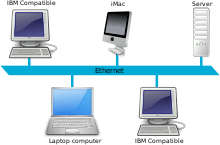
A local area network is privately owned and links the devices in a single, office or building. Its design allow the hardware and software resources such as printer and application program to be shared between workstations. The size is limited is limited to a small geographical area.
2 Metropolitan Area Network (MAN)
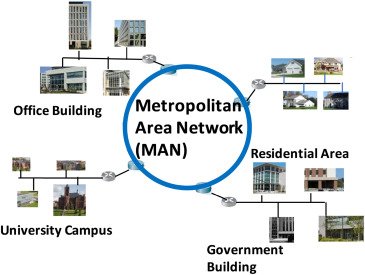
A Metropolitan Area Network is that type of network which connects user and computing resources in common geographic area which is larger than LAN but smaller than WAN. This network builds up with multiple LANs, and provide a fast communication through fiber optic cables. It is used to connect businesses to businesses and businesses to WANs.
Wide Area Network.
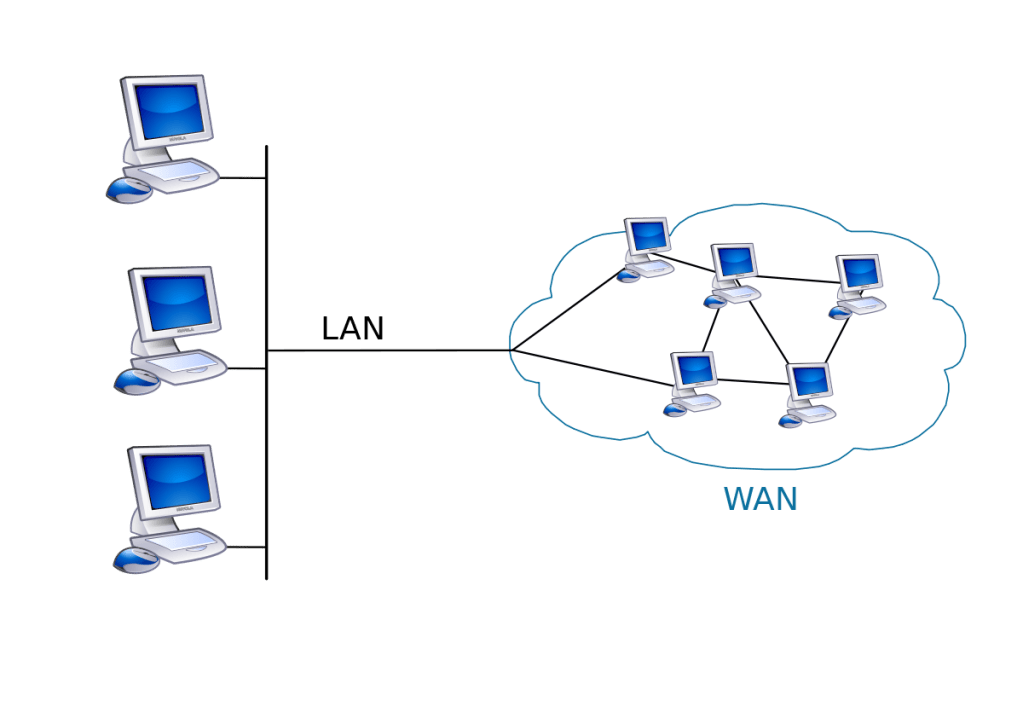
A wide area network is a telecommunication network consists of devices that are connected through communication links such as telephone lines or satellites. We can say that WAN comprises of two or more LANs or MANs networks. Wired or wirless both techniques are included in WAN connections.
Components of Computer networks.
There are five basic components for computer network
1.Sending devices.
Any device that is capable of sending information or instructions
2.Receving devices.
Any device that is capable of receiving information or instructions
3 Communication devices.
Any hardware device that is used for transmission of instructions, data or information between sending and receiving devices are known as communication devices.
Sending device is also called source and receiving is called destination.
4 Transmission Medium.
It is also known as transmission channel. Basically its a path through which data is transmitted.
5 Protocols
It is the set of rules that govern communication among the devices.
Computer Networks.
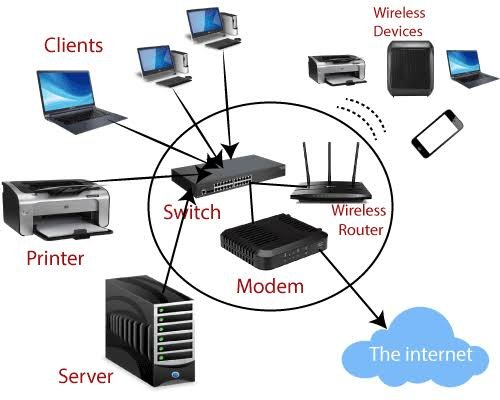
A computer network is the combination of various computing devices that are connected together by communication links for the purpose of sharing information. These devices are generally called node. A node can be any device capable of sending and receiving data such as laptop, mobile phones, router, switches and desktop systems etc.
We can say a proper communication is the combination of connection and protocol. A network connection can be established through cables or wireless media. Every computer consists of hardware and software and protocols that connects various nodes in a computer network.
Computer networks can be classified by their size, connectivity, medium, mobility, and transmission.
By Size. PAN, LAN, WAN, MAN
By Connectivity. Topologies
By Medium. Wired, Wireless
By Mobility. Fixed, Mobile
By Transmission. Broadcast, point-to-point
 New Technologies